Lao People's Revolutionary Party Advances Third Political Program In Group's History
The goals include ambitious policy orientations like "developing a socialist-oriented market economy," seemingly following the economic line of other ruling socialist parties.
This article was first published in an earlier version of this site on August 17, 2026.
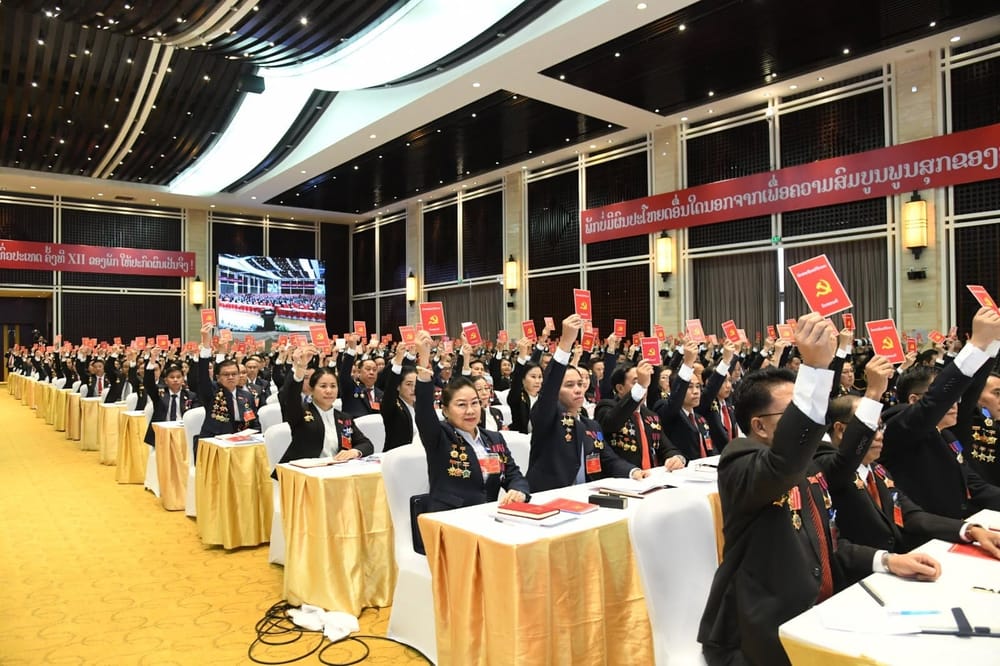
The Lao People's Revolutionary Party approved a new political program extended at the 12th National Congress of the Lao People's Revolutionary Party (LPRP) earlier this year, the third in the organization's 71-year history.
The program outlines 11 strategic points for the party's vision for 2055, ultimately highlighting the principal goal of developing Laos into a "high middle-income country" with a "modern economy and strong political system," Xinhua reported in January. The goals include ambitious policy orientations like "developing a socialist-oriented market economy," seemingly following the economic line of other ruling socialist parties like the Communist Party of China (CPC), the Communist Party of Vietnam (CPV), and, most recently, the Workers' Party of Korea (WPK).
Specific key goals for the LPRP's third political program include maintaining GDP growth above 6 percent, ensuring universal access to healthcare and education, and promoting digital transformation, the latter point likely being a nod toward the continued expansion of the country's fiber-optic and 5G network, as well as the further development of digital literacy among its people.
The ruling party also outlined its aim to progress the Lao People's Democratic Republic out of the UN's list of "least developed countries" (LDCs) by 2030. This list currently includes 44 countries, which are designated LDCs based on three metrics: average income, a rubric measuring factors of health and education, and a rubric measuring economic and environmental vulnerability.
Overall, it represents a generational shift for the LPRP. Replacing the second political program adopted all the way back in 1972, it establishes what are likely to be the party's central tasks for the next three decades, by which point the Lao People's Democratic Republic will surely look indistinguishable from its current form in 2026.
More on Lao People's Revolutionary Party: Lao PDR Clean Energy Day 2026 to promote national energy